70/25 Lecture 3C Understanding Earth’s Ecosystem Services and Human Well-being
Posted 11 months ago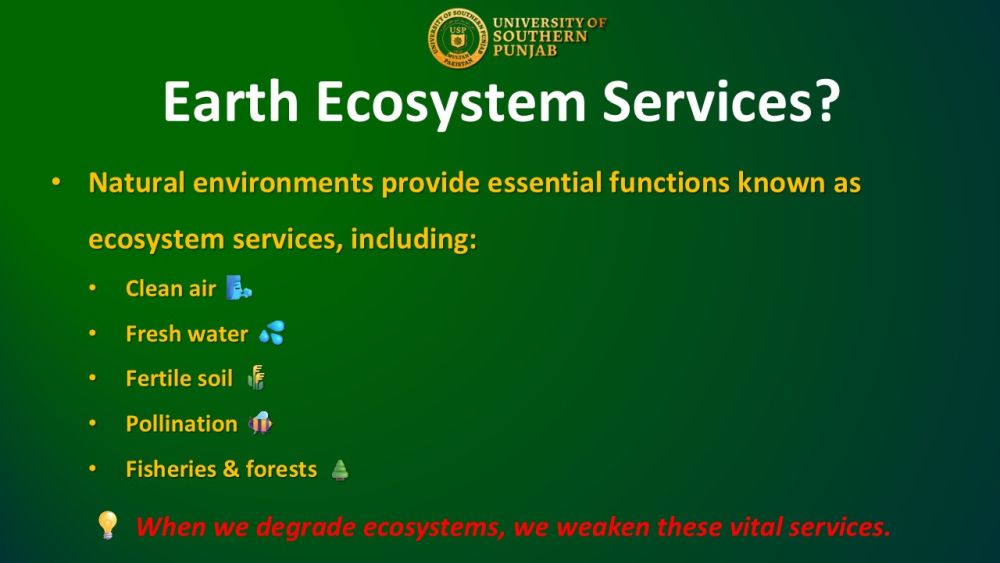
Video for Lecture 3C is available HERE
Earth’s Ecosystem Services
Ecosystem services are our planet's (Earth) life-support systems, nature’s invisible yet indispensable work that sustains human civilization. These services represent humans' benefits from natural ecosystems, encompassing clean air and water to fertile soil and crop pollination.
Nature’s quiet generosity is astonishing. Forests absorb carbon dioxide and release oxygen; wetlands purify water; bees pollinate our food crops; oceans regulate the planet’s climate; and fertile soil sustains our agriculture. Together, these processes create a delicate equilibrium that supports all living systems—including ours.
When we overexploit natural resources, destroy forests, pollute rivers, or alter the climate, we weaken the systems that make life possible. Degrading these services—through deforestation, overfishing, or global warming—undermines food security, public health, and economic stability.
Hence, protecting ecosystem services is not a luxury but an existential necessity. Preserving them ensures resilience, prosperity, and intergenerational justice for humanity.
How Ecosystem Services Affect Humans
Ecosystem services influence our daily lives, often in overlooked ways. We realize their value only when they are not available.
- Deforestation disrupts rainfall and soil stability, leading to floods and agricultural loss.
- Air pollution harms human health, causing respiratory diseases and premature deaths.
- Overfishing destabilizes marine food webs, threatening livelihoods and nutrition.
Environmental science is a diagnostic and preventive discipline, helping societies identify, measure, and restore ecological functions before they collapse. Through research, monitoring, and sustainable management, we can sustain the natural services upon which human prosperity depends.
When we reforest degraded lands, reduce industrial emissions, or protect coral reefs, we are, in effect, maintaining the Earth’s life-support machinery. Sustainability begins when we recognize that ecological health and human welfare are inseparable.
Environmental Health Indicators: The Planet’s Vital Signs
Just as physicians rely on vital signs to assess human health, environmental scientists use indicators to gauge the condition of Earth’s systems.
Key environmental indicators include:
- Atmospheric CO₂ levels – indicate climate stability and the extent of anthropogenic impact.
- Ocean acidity (pH levels) – signal changes in marine biodiversity and coral health.
- Soil fertility and erosion rates – reflect agricultural sustainability.
- Biodiversity levels – reveal ecosystem resilience and adaptive capacity.
By systematically monitoring these parameters, scientists can detect ecological distress before it becomes irreversible. This evidence-based understanding enables policymakers to design interventions, such as emission controls, conservation laws, and renewable energy transitions, to restore environmental equilibrium.
Environmental indicators are, therefore, humanity’s early-warning system for planetary well-being.
Human Health and the Environment
Human health is linked to the environment we live in. When the environment falters, humanity suffers.
- Climate change intensifies heatwaves, floods, and vector-borne diseases.
- Loss of biodiversity eliminates natural disease buffers and destabilizes food systems.
- Polluted water spreads infectious diseases and entrenches poverty.
- Airborne toxins compromise respiratory and cardiovascular health.
The relationship is circular: environmental degradation harms health, and unsustainable human behavior worsens environmental decline. The solution is integrated approaches combining ecological science, public health, and social responsibility.
In essence, to heal humanity, we must heal the planet. Environmental science is data-driven, ethically grounded, and globally minded, offering both the diagnosis and the cure.
Possible Examination Questions and Model Answers
I. Multiple Choice Questions (MCQs)
- Which of the following best defines ecosystem services?
A. Human technologies that replace natural processes
B. Benefits humans obtain from functioning ecosystems
C. Industrial systems that process natural resources
D. Economic systems that support trade in natural goods
Answer: B. Benefits humans obtain from functioning ecosystems
- Which of the following is an example of a regulating ecosystem service?
A. Pollination by bees
B. Carbon sequestration by forests
C. Timber production
D. Recreational tourism
Answer: B. Carbon sequestration by forests
- Why are biodiversity levels considered an environmental indicator?
A. They measure soil fertility directly.
B. They reflect the resilience and balance of ecosystems.
C. They are unrelated to ecosystem health.
D. They only indicate the number of plant species.
Answer: B. They reflect the resilience and balance of ecosystems
- Which of the following environmental problems is most directly linked to human health?
A. Air pollution and respiratory diseases
B. Noise pollution and coral bleaching
C. Ozone depletion and earthquakes
D. Deforestation and magnetic field changes
Answer: A. Air pollution and respiratory diseases
II. Short Answer Questions
- Define ecosystem services and explain why they are essential for human survival.
Answer: Ecosystem services are the benefits people derive from natural environments, such as clean air, water purification, pollination, and soil fertility. They are essential because they sustain life, support economic productivity, and maintain the ecological balance required for human health and survival.
- What are environmental indicators, and why are they important?
Answer: Environmental indicators are measurable variables—such as CO₂ concentration, biodiversity levels, and soil fertility—that provide information about the environment's health. They are crucial for detecting changes, diagnosing ecological stress, and guiding sustainable management practices.
- Explain how deforestation can disrupt ecosystem services and affect human communities.
Answer: Deforestation reduces carbon sequestration, alters rainfall patterns, and increases soil erosion. These disruptions lead to flooding, loss of agricultural productivity, and increased vulnerability of communities to climate-related disasters.
III. Analytical / Essay Questions
- Discuss how ecosystem services underpin economic and social stability.
Answer: Ecosystem services form the foundation of economies by providing natural capital, such as fertile soil, water, and pollinators, that enable food production, industry, and trade. Their degradation leads to economic losses, food insecurity, and social unrest. Thus, ecological health is directly linked to economic resilience and human welfare.
- Evaluate the relationship between environmental indicators and sustainable development goals (SDGs).
Answer: Environmental indicators serve as quantitative benchmarks to monitor progress toward the SDGs, particularly those related to climate action, clean water, life on land, and life below water. They provide scientific data for informed decision-making and ensure accountability in achieving sustainability targets at global and national scales.
- Critically analyze the statement: “To protect human health, we must protect the environment.”
Answer: Human health depends on clean air, safe water, nutritious food, and a stable climate, all of which arise from healthy ecosystems. Environmental degradation leads to diseases, malnutrition, and disasters. Hence, environmental protection is a preventive form of public health intervention. Sustainable environmental policies are, therefore, health policies in disguise.
The University of Southern Punjab, Multan, Pakistan, recognizes education as a shared social responsibility and a powerful instrument for community uplift. The University reinforces its commitment to environmental awareness, sustainable living, and civic engagement by offering the Introduction to Environmental Science course to students and the general public. This initiative enriches students’ understanding of how natural systems support life and empowers the wider community to make informed decisions for a cleaner, healthier, and more sustainable future. Through this program, USP takes a leading role in transforming knowledge into action, inspiring and motivating the collective well-being of South Punjab and beyond.