The Invisible Shield: How Earth’s Atmosphere Protects, Warms, and Sustains Life
Posted 9 months ago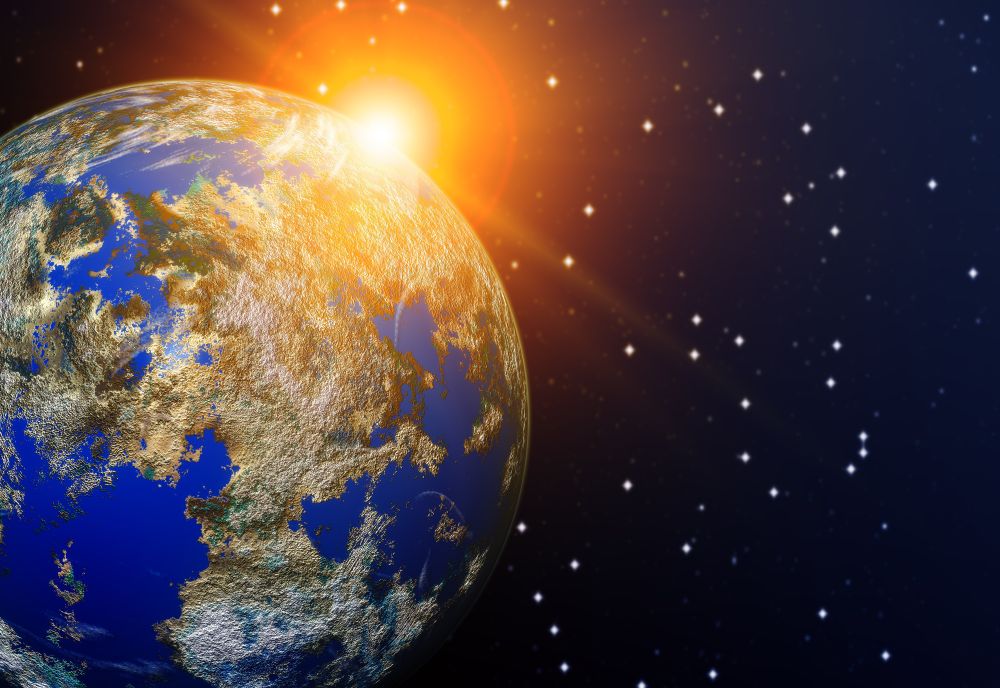
79/25 - Sun Shining on the Earth
If you were to step outside on any morning and look up, you would see nothing unusual, just open blue sky, maybe some drifting clouds, perhaps a soft haze or a golden sunrise. It feels ordinary, almost forgettable. Yet everything you see, or don’t see; is part of one of the most extraordinary systems on our planet: Earth’s atmosphere.
Despite being invisible and often ignored, this delicate envelope of gases is what makes Earth alive. It is the silent architect of our weather, the guardian of our climate, and the constant companion that enables every breath we take. It shields us from harmful solar radiation, moderates the planet’s temperature, and makes possible the chemistry that sustains plants, people, and ecosystems. Without it, Earth would be nothing more than a cold, barren rock floating through space.
The atmosphere is not a single, uniform blanket. It is a layered system, each level performing a specific, remarkable task. The lowest layer, the troposphere, is the one we live in—home to 80 to 90 percent of all atmospheric mass and the birthplace of every raindrop, storm, gust of wind, and drifting cloud. Higher above lies the stratosphere, which contains the ozone layer, a thin yet crucial shield that filters harmful ultraviolet rays. Without this natural sunscreen, life on Earth would be bombarded by radiation that damages DNA and disrupts ecosystems.
Beyond these familiar zones lies the mesosphere, a frigid realm where temperatures can plunge to –90°C and where incoming meteors burn up before they ever reach the ground. Higher up still is the thermosphere, a region so hot—over 1,800°C, that metals would melt, yet paradoxically so thin that you would feel no heat at all. This is the domain of the auroras dancing in polar skies, the playground of radio signals skipping across continents, and the orbital highway of satellites and the International Space Station.
But the atmosphere is more than just layers stacked above our heads. It is the stage upon which the Sun performs a daily show of heating and cooling. Every morning, sunlight travels millions of kilometers across space before filtering through these atmospheric layers. Most of this energy reaches Earth’s surface, warming land, oceans, and air. In return, the Earth radiates this warmth back upward as infrared radiation.
This natural exchange, Sunlight in, heat out is the foundation of life-sustaining temperatures. But the atmosphere adds an ingenious twist. Certain gases, including carbon dioxide, methane, and water vapor, absorb some of the outgoing heat and re-emit it back toward Earth. This creates the natural greenhouse effect, which acts like a thermal blanket around the planet.
Without this effect, Earth’s average temperature would hover around -18 °C, making life nearly impossible. Instead, thanks to this atmospheric “blanket,” we enjoy a comfortable average of about 15°C.
Yet this very system, so elegantly balanced, is now under strain. Human activities—burning fossil fuels, clearing forests, and expanding industry—have dramatically increased the concentration of these greenhouse gases. The result is excessive heat trapping, leading to global warming and the climate disruptions we now experience, including rising temperatures, stronger storms, unpredictable rainfall, and shifting seasons.
The atmosphere, once a silent protector, is now sending unmistakable signals of distress.
Understanding this invisible system is no longer simply a matter for scientists. It is essential for every citizen, every student, every policymaker, and every community. The atmosphere is everyone’s business. It sustains the world we know and the future we hope to preserve.
In the end, the atmosphere may be unseen, but its impact surrounds us every moment—carried in each breath we take, each cloud drifting overhead, and each sunrise warming the world once again.
Potential Questions for Students
1. In simple words, what is the atmosphere, and why is it essential?
- Expected Answer: The atmosphere is the layer of gases surrounding Earth. It makes life possible by providing breathable air, protecting us from harmful radiation, regulating temperature, and supporting weather and climate.
2. Describe the major layers of the atmosphere in order from lowest to highest.
- Expected Answer: Troposphere, Stratosphere, Mesosphere, Thermosphere.
Each layer has unique temperature patterns and functions.
3. What is the greenhouse effect, and why is it necessary for life on Earth?
- Expected Answer: It is the process where certain gases trap some of the Earth’s outgoing heat, keeping the planet warm. Without it, Earth would be too cold for life.
4. How are human activities affecting the natural greenhouse effect?
- Expected Answer: Human activities release too many greenhouse gases, causing excessive heat trapping and leading to global warming.
5. Why is understanding the atmosphere important for environmental science?
- Expected Answer: Because the atmosphere controls weather, climate, heat balance, and radiation protection. Understanding helps us address climate change, pollution, and sustainability.
Multiple Choice Questions
1. What is the main gas found in Earth’s atmosphere?
A. Oxygen
B. Carbon dioxide
C. Nitrogen
D. Ozone
Correct Answer: C. Nitrogen
2. Which layer of the atmosphere contains the ozone layer?
A. Troposphere
B. Stratosphere
C. Mesosphere
D. Thermosphere
Correct Answer: B. Stratosphere
3. In which atmospheric layer does all weather occur?
A. Thermosphere
B. Mesosphere
C. Stratosphere
D. Troposphere
Correct Answer: D. Troposphere
4. Why does the temperature increase in the upper stratosphere?
A. Because of volcanic activity
B. Due to absorption of UV radiation by ozone
C. Because the Sun directly heats it
D. Due to greenhouse gases
Correct Answer: B. Due to absorption of UV radiation by ozone
5. What happens to most meteors entering the Earth’s atmosphere?
A. They pass safely to the ground
B. They burn in the mesosphere
C. They bounce back into space
D. They melt in the thermosphere
Correct Answer: B. They burn in the mesosphere
6. The greenhouse effect is best described as:
A. A rise in sea levels
B. A natural process that traps heat in the atmosphere
C. A type of pollution
D. A process that cools Earth
Correct Answer: B. A natural process that traps heat in the atmosphere
7. Which gas is a major contributor to human-caused global warming?
A. Nitrogen
B. Oxygen
C. Carbon dioxide
D. Argon
Correct Answer: C. Carbon dioxide
8. What would Earth’s average temperature be without the natural greenhouse effect?
A. 30°C
B. 15°C
C. –18°C
D. 45°C
Correct Answer: C. –18°C
9. The thermosphere is known for: