NSU Sarmad Tanveer Campus Muridke, Sheikhupura Campus Director Article on Climate Change Praised Across the Globe
Posted 1 day ago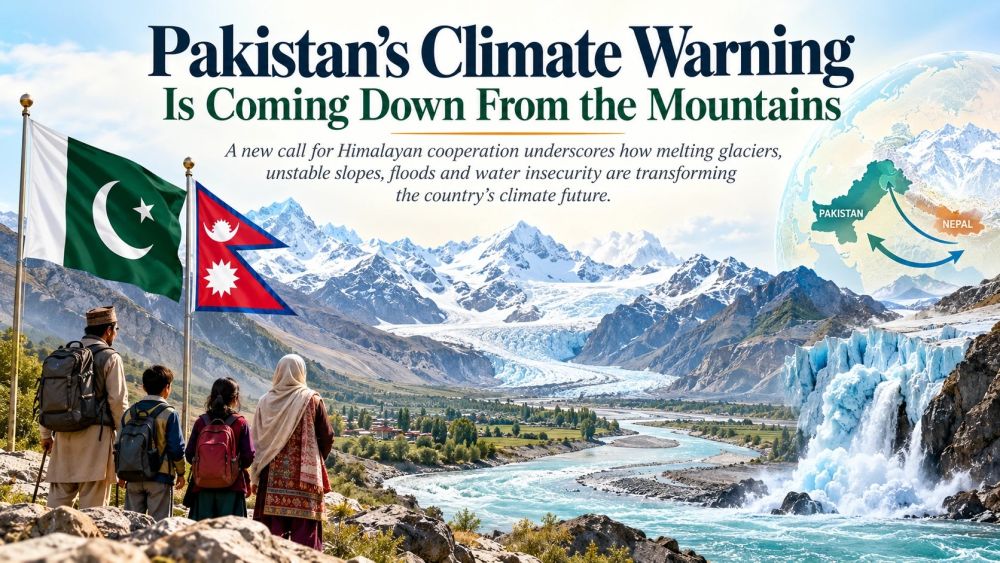
44/2026
A new call for Himalayan cooperation underscores that melting glaciers, unstable slopes, floods, and water insecurity are reshaping the country’s climate future.
High in the mountains, warning signs are growing harder to ignore. Glaciers are retreating, ice and rock slopes are increasingly unstable, rivers are behaving unpredictably, and communities living beneath the great Himalayan ranges are confronting hazards once considered rare or distant. For Pakistan, a country already repeatedly tested by floods, droughts, and extreme temperatures, the changing mountain environment is becoming one of the most consequential dimensions of the climate crisis.
Against this backdrop, Professor Emeritus Dr. Muhammad Mukhtar, Rector of the University of Southern Punjab, Multan, Pakistan, and former Founding Vice Chancellor of the National Skills University Islamabad (NSU), has congratulated Prof. Emeritus Dr. Robina Farooq on her significant contribution to the national climate debate through her article, “Himalayan Diplomacy: A New Frontier for Pakistan–Nepal Climate Cooperation,” published in Dawn. He also congratulated Professor Dr. Saud Altaf, Vice Chancellor of the National Skills University Islamabad, Pakistan, and the entire NSU faculty, employees, and academic community, describing Dr. Farooq’s work as scholarship that connects universities with society’s most pressing challenges. Professor Emeritus Dr. Robina Farooq serves as Director of the NSU Sarmad Tanveer Campus in Muridke, Sheikhupura. She served as Vice Chancellor of the Government Women College Faisalabad University, served for eight years as a Senate Member of the National Skills University Islamabad, and is currently appointed as Professor Emeritus and Campus Director at the NSU Sarmad Tanveer Campus, Muridke, Sheikhupura.
The significance of Dr. Farooq’s contribution lies not only in documenting the effects of climate change but also in asking what Pakistan and its neighbors can do together before the next disaster strikes. Her analysis places Pakistan and Nepal within a shared Himalayan climate system, where melting glaciers, shifting weather patterns, unstable slopes, and glacial lakes create risks that transcend political boundaries.
In her accompanying interview, Dr. Farooq argues that the apparent distance between Pakistan and Nepal is misleading. Both countries are affected by a changing Himalayan ecosystem, and developments in one mountain region can warn of what may eventually occur elsewhere. Pakistan’s northern areas, including Hunza, Chitral, Gilgit and Swat, face hazards that mirror those emerging elsewhere in the Himalayan region.
That shared vulnerability, she suggests, should form the foundation for a new form of regional cooperation: climate diplomacy built on science, data and the protection of communities.
The urgency is difficult to overstate. Dr. Farooq points to the rapid acceleration of glacial melting and the growing danger posed by unstable ice, rock, and glacial lakes. Pakistan, she notes, has thousands of lakes, with dozens vulnerable to potentially catastrophic outburst events. Nepal faces comparable dangers. The two countries therefore have an unusual opportunity to learn from one another before their vulnerabilities lead to larger disasters.
The Warning Before the Disaster
Modern science can already detect many of the signals that precede a mountain disaster.
Satellite imagery can reveal changes in glaciers and slopes. Scientists can observe prolonged warming, rising ground temperatures, weakening ice-rock formations, extreme precipitation, and shifts in the freezing level. Cracks in mountain formations and vibrations detected by acoustic sensors can provide additional evidence that something is shifting. River gauges can reveal sudden changes in water levels.
But science has its limits.
Scientists may know a mountain system is becoming dangerous but cannot predict the exact hour when a landslide, avalanche, or glacial lake outburst will occur. That uncertainty makes preparedness more important, not less.
For Dr. Farooq, the most dangerous gap is not necessarily a lack of scientific knowledge. It is the gap between warning and action.
A warning must reach those who need it. Communities must understand what the warning means. They must know where to go, which routes are safe, and how quickly they must move. In some mountain emergencies, there may be only minutes to escape.
This turns climate adaptation into a question not only of technology but also of governance, communication, and public trust.
When the Mountains Change, the Plains Feel It
Pakistan's climate story cannot be confined to the northern mountains.
The glaciers and snowfields of the highlands are part of a water system that sustains communities, agriculture, energy production, and ecosystems far downstream. A rapidly changing mountain environment can therefore produce seemingly contradictory outcomes: destructive floods today and water scarcity tomorrow.
Dr. Farooq warns that glacier retreat can eventually leave communities facing drought, inadequate clean drinking water supplies, and energy insecurity.
For a country whose economy and food production depend heavily on water, this is not merely an environmental concern. It is a question of national resilience. Pakistan’s climate challenge is consequently much broader than the familiar debate over emissions. It encompasses water management, agriculture, urban planning, public health, disaster preparedness, forests, infrastructure, and the future of communities living in environmentally fragile areas.
Learning From Nepal - and From Pakistan
One of the most constructive aspects of Dr. Farooq’s argument is that Pakistan and Nepal should not approach climate cooperation merely as vulnerable countries seeking assistance. Both possess knowledge and practical experience that can benefit the other.
Pakistan has developed community-based early-warning mechanisms, weather stations, and river gauges, and has experience preparing communities for glacial lake outburst floods. Nepal, meanwhile, has pursued engineering interventions to reduce the risks posed by dangerous glacial lakes.
The lesson is straightforward: the best climate diplomacy may begin with sharing what works.
Scientists could exchange real-time information on glacier movement, lake levels, and unstable slopes. Technical teams could jointly review warning systems. Universities could establish collaborative research programs. Disaster-management agencies could compare evacuation strategies. And perhaps most importantly, communities could be integrated into the system rather than treated simply as recipients of official warnings.
Local knowledge has a place alongside satellite imagery and sophisticated scientific instruments. Villagers may notice a new crack, an unusual stream, a sudden change in river behavior, or another subtle alteration in the landscape before a formal monitoring system detects it.
The Forests That Stand Between People and Disaster
The climate equation also extends into Pakistan’s forests.
Dr. Farooq points to Nepal’s forest cover and contrasts it with Pakistan’s much smaller forested area, arguing for sustained attention to afforestation, community participation, and protecting existing forests. She also highlights the ongoing threat of illegal logging.
Forests can stabilize mountain slopes, reduce erosion, and help ecosystems absorb the impacts of extreme weather. Their destruction can make fragile landscapes even more vulnerable.
That makes initiatives such as Pakistan’s tree-planting programs more than symbolic environmental campaigns. Their effectiveness will depend on continuity, monitoring, community ownership, and protection against deforestation.
The broader principle, one Dr. Farooq repeatedly emphasizes, is that nature itself must become part of Pakistan’s climate defense system.
From Reacting to Preparing
Perhaps the strongest message from the interview is that Pakistan must change its relationship with disaster. Too often, the national response begins after the water has risen, the mountain has collapsed, or the village has already been evacuated. Emergency relief is necessary, but it cannot replace prevention.
Dr. Farooq argues for nature-based solutions, stronger preparedness, and measures to protect communities before a catastrophe occurs.
That philosophy would require a significant shift in public policy, from counting losses after disasters to measuring risks before they occur.
It would mean identifying vulnerable settlements, strengthening evacuation routes, protecting watersheds, improving floodplain planning, restoring ecosystems, and ensuring that early-warning messages reach the last household in danger.
It would also mean asking a difficult question before building infrastructure: should it be built there?
A Role for Universities Beyond the Classroom
In this context, Professor Dr. Mukhtar’s felicitation of Dr. Farooq and the National Skills University holds significance beyond a conventional academic tribute.
Universities are often described as places where knowledge is produced. Increasingly, however, they are being asked to demonstrate what that knowledge can accomplish.
Dr. Farooq’s work illustrates this transition. Her research and public engagement bring together climate science, disaster preparedness, environmental protection, regional diplomacy, and community safety. Professor Dr. Mukhtar’s recognition also underscores the role of academic institutions in encouraging scholars to engage with issues that affect millions of lives.
Professor Dr. Mukhtar congratulated Prof. Emeritus Dr. Robina Farooq on her insightful scholarship and public contributions, and commended Professor Dr. Saud Altaf and the entire National Skills University Islamabad faculty for fostering an academic culture in which research extends beyond the university and contributes to national and international conversations.
For Pakistan, such scholarship is particularly valuable at a moment when climate change is no longer a prediction about the future.
It is visible in the mountains.
It is moving through the rivers.
It is altering the seasons.
And it is arriving sooner and more forcefully than many communities are prepared for.
The challenge now is whether Pakistan can turn those warnings into action and whether the Himalayas can become not merely a frontier of climate vulnerability but also a frontier of scientific cooperation, shared knowledge, and regional resilience.
Prof. Dr. Robina Farooq’s call for Himalayan cooperation offers one possible beginning.