How Electric Vehicles Are Saving Lives, Not Just the Climate – A report from China
Posted 3 months ago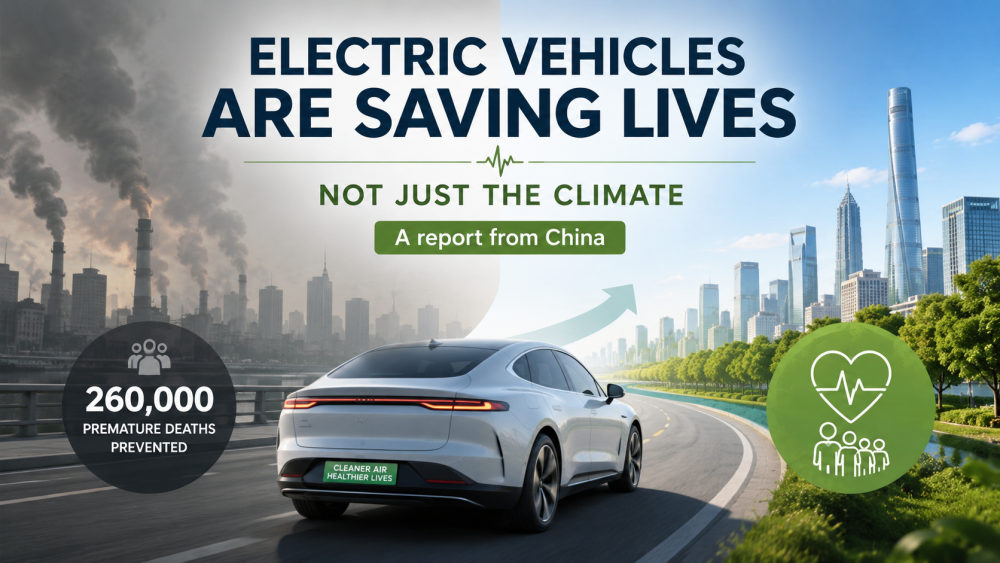
24/2026
This article is based on a recent publication in the Journal Nature, which describes how the rapid adoption of electric vehicles (EVs) in China has reduced air pollution and prevented an estimated 260,000 premature deaths.
When people think about electric vehicles, they usually picture a future with lower carbon emissions, quieter streets, and less dependence on fossil fuels. But a growing body of evidence suggests that the most immediate benefit of the electric-car revolution may be far more personal: longer, healthier lives.
Across China, the world’s largest electric-vehicle market, a remarkable public-health experiment has been unfolding in real time. As millions of drivers have traded gasoline-powered cars for battery-powered alternatives, researchers have observed measurable declines in urban air pollution. The consequences extend far beyond cleaner skies. According to a recent study, the transition to electric mobility has already prevented about 260,000 premature deaths linked to air pollution.
The finding offers one of the clearest demonstrations that transportation policy is also health policy.
A Nation on the Move
China's embrace of electric vehicles has been unprecedented. Over the past decade, government incentives, technological innovation, and expanding charging infrastructure have transformed EVs from a niche technology into a mainstream mode of transportation. Today, Chinese cities are home to millions of electric cars, buses, and delivery vehicles.
This transition has occurred amid a long-standing environmental challenge. Rapid industrialization and urban growth brought prosperity to China, but they also caused severe air pollution. For years, smog-filled skies became a familiar sight in many metropolitan areas, raising concerns about respiratory and cardiovascular illnesses and reduced life expectancy.
Scientists have known for decades that pollutants from vehicle exhaust, including fine particulate matter and nitrogen oxides, can penetrate deep into the lungs and bloodstream. These pollutants contribute to heart attacks, strokes, chronic lung disease, and other life-threatening conditions. Even modest reductions in exposure can yield significant public health benefits.
Cleaner Streets, Healthier Citizens
The new analysis suggests that replacing conventional vehicles with electric ones is helping to reduce several harmful pollutants in many Chinese cities. Fewer fossil-fuel vehicles on the road mean less combustion and, consequently, fewer toxic emissions entering the atmosphere.
The health implications are profound. Air pollution is often called an “invisible killer” because its effects accumulate gradually and silently. Individuals may never realize that the asthma attack, heart disease, or respiratory complication they experience years later was influenced by the air they breathe every day.
By reducing pollution exposure across entire populations, electric vehicles can deliver benefits that are difficult to see but impossible to ignore at the national scale. Hundreds of thousands of lives saved represent not merely a statistical achievement but also families spared the loss of loved ones, communities retaining productive citizens, and healthcare systems facing fewer pollution-related illnesses.
Lingering Issues
Researchers note that while electric vehicles reduce many harmful emissions, they do not eliminate all sources of urban pollution. Particles from tire wear, road dust, and brake systems can still degrade air quality. Moreover, the environmental benefits of EVs depend partly on how the electricity used to charge them is generated. If electricity comes from coal-fired power plants, some pollution is effectively shifted from city streets to power-generation facilities.
This complexity highlights an important lesson in environmental science: technological solutions are most effective when integrated into broader systemic changes. Cleaner transportation works best when accompanied by cleaner electricity generation, improved urban planning, and stronger environmental regulations.
Highlighting Public Health Benefits of Electric Cars
Historically, environmental policies have often been evaluated through the lens of economics or climate protection. Yet the Chinese experience suggests that public health benefits may be among the strongest arguments for accelerating the transition away from fossil-fuel-based transportation.
Unlike climate benefits, which often unfold over decades, health gains can emerge within years. Reduced exposure to pollutants leads to fewer hospital admissions, lower healthcare costs, and improved quality of life. In economic terms, healthier populations are also more productive.
For policymakers worldwide, this presents a compelling case. Investments in electric transportation are not merely expenditures aimed at reducing future climate risks; they can also yield immediate returns in the form of healthier citizens.
A Preview of the Future
China's experience may offer a glimpse into what lies ahead for other nations pursuing large-scale transportation electrification. As battery costs continue to decline and charging networks expand, electric vehicles are becoming increasingly accessible worldwide.
The broader lesson extends beyond automobiles. It shows that environmental interventions can deliver tangible human benefits on a massive scale. Cleaner technologies are not only about preserving ecosystems or meeting emissions targets but also about reducing disease, extending life expectancy, and improving daily well-being.
The electric vehicle was initially marketed as a climate solution. It is now emerging as something even more powerful: a public health intervention on wheels. If current trends continue, the electric-car revolution's greatest legacy may not be the carbon it avoids but the lives it saves.