Green Spaces, Safe Streets and Better Affordable Housing: What Makes a City Truly Livable
Posted 1 month ago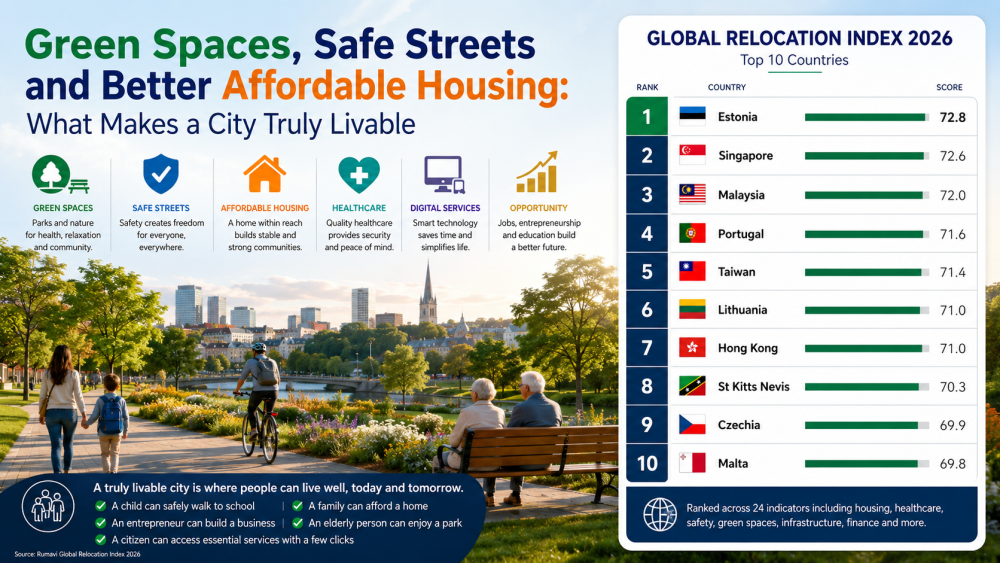
38/2026
According to the Rumavi Global Relocation Index 2026, Estonia is the world's best place to live, ahead of destinations such as Singapore and Malaysia. The assessment considered 24 indicators, including housing, healthcare, safety, green spaces, infrastructure, finance, and business opportunities.
But Estonia's success goes beyond a country's ranking. It offers a useful blueprint for understanding what makes a city genuinely livable.
Quality of Life Begins with Everyday Life
The best cities reduce the friction of ordinary living.
People should be able to find a comfortable home, travel safely, access healthcare, communicate with the government, enjoy public spaces, and reach work without losing hours to traffic or bureaucracy. These may sound modest, but together they determine whether urban life feels liberating or exhausting.
Estonia's strong performance reflects this combination. The 2026 assessment highlighted its green spaces, housing affordability, street safety, healthcare and digital infrastructure.
Parks, trees, gardens, walking trails, and natural landscapes are not merely decorative additions to a city. They provide places to exercise, relax, meet others, and escape the intensity of urban life. Estonia's strong performance in green spaces was one factor contributing to its high quality-of-life ranking.
A truly livable city should allow people to experience both urban opportunity and natural tranquility in their everyday lives.
Safety Creates Freedom
A truly livable city is one where people feel comfortable walking through their neighborhoods, using public transportation, and enjoying public spaces.
Safety is more than the absence of crime. It creates freedom, including the freedom for children to play outdoors, older people to walk independently, and families to enjoy their city after dark.
When residents trust their streets and institutions, cities become more vibrant and connected.
Affordable Housing Matters
Even the most beautiful city becomes difficult to love when its residents cannot afford to live there.
Housing is therefore a cornerstone of quality of life. Estonia's relatively strong performance on housing affordability demonstrates an important principle: economic success should not come at the cost of making ordinary people homeless or financially overwhelmed.
A successful city must be affordable not only to investors and high-income professionals but also to teachers, nurses, researchers, entrepreneurs, and young families.
Nature Is Part of Urban Health
Parks, trees, walking paths and accessible natural spaces are not simply decorative features.
They provide places to exercise, relax, meet others, and escape the intensity of urban life. Estonia scored strongly for green spaces in the 2026 assessment.
The lesson is becoming increasingly clear: the smartest cities do not choose between development and nature; they design for both.
Healthcare Provides Security
Good healthcare is another essential component of livability.
Residents need confidence that when illness or injury strikes, quality medical care will be accessible and dependable. Estonia's healthcare system received a strong score in the 2026 assessment.
That confidence has value beyond medicine. It reassures people that an unexpected health crisis will not automatically become a personal catastrophe.
Technology Should Give People Time Back
Estonia is particularly interesting because of its sophisticated digital government.
Digital services can improve quality of life by letting citizens complete routine government tasks online rather than spending hours traveling to offices, filling out paperwork, and waiting in queues.
The principle is simple: technology should make life easier, not merely make a city look futuristic.
The best digital city is therefore not necessarily the one with the most gadgets. It is the one where residents barely notice the technology because it simply works.
Opportunity Completes the Picture
Livability also requires economic opportunity.
People need good jobs, education, entrepreneurship, and the opportunity to build a better future. Estonia performed particularly well in the 2026 assessment of business opportunities and entrepreneurial conditions.
This reveals an important truth: prosperity and quality of life should reinforce one another.
A city needs both opportunity and wellbeing.
The World's "Best" City Is Different for Everyone
No ranking can identify a perfect place for every human being.
Climate, culture, family circumstances, profession, and personal priorities all influence where someone wants to live. Estonia, for example, scores well across many quality-of-life dimensions, but its colder climate may not suit everyone.
Yet the fundamentals of a good city are surprisingly universal.
People want safety, affordable housing, healthcare, nature, mobility, opportunity, reliable institutions, and time for life beyond work.
The New Measure of Urban Success
For decades, cities measured success through skyscrapers, economic growth, and investment.
The future may require a more meaningful question:
How well does the city help its people live?
The world's most successful city may not be the one with the tallest buildings or the biggest economy. It may be the one where a child can safely walk to school, a family can afford a home, an entrepreneur can build a business, an older adult can enjoy a park, and a citizen can access essential services with a few clicks.
That is the deeper lesson from Estonia's rise in the 2026 ranking.