Global Warming Is Stealing Our Sleep and Good Health
Posted 1 month ago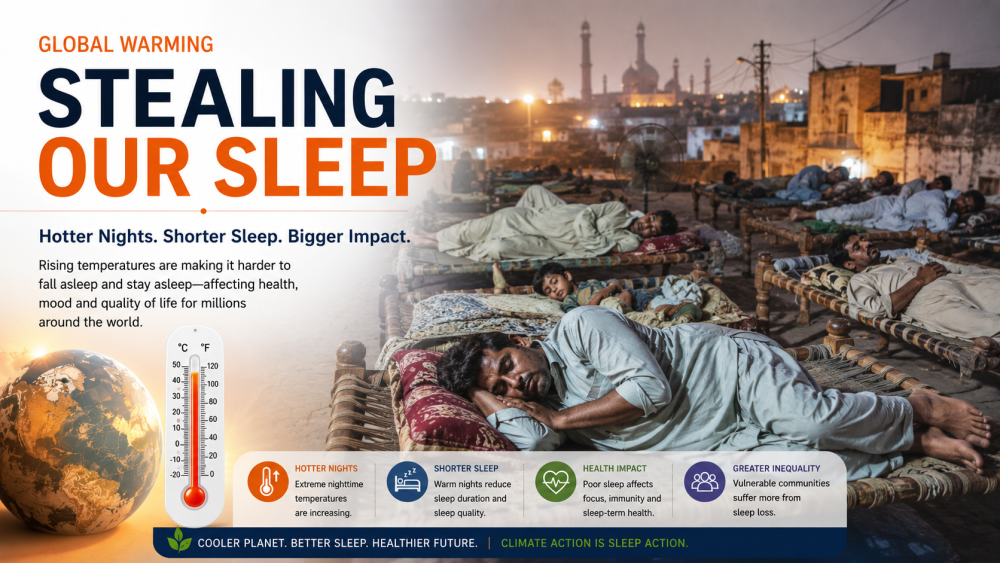
36/2026
We often think of climate change as a story about melting glaciers, rising seas, and dangerous heatwaves. But another, quieter consequence of a warming planet is that it is becoming harder to sleep.
Our bodies are designed to cool down during sleep. As bedtime approaches, core body temperature naturally drops, helping the brain and body fall asleep and stay asleep. Hot nights disrupt this process. When the bedroom stays warm, the body struggles to release heat, making it harder to fall asleep and easier to wake during the night.
The problem is worsening as nights warm. A recent Nature article highlights that extreme nighttime temperatures are increasingly common, including exceptionally warm nights in South Asia and Europe. The scientific evidence is increasingly compelling. A systematic review of research worldwide found that higher outdoor and indoor temperatures are generally associated with shorter, poorer-quality sleep, with effects particularly strong during the hottest periods and among vulnerable populations.
The scale of the problem is striking. Data from a scientific study analyzing more than 7 million sleep records from 47,000 people in 68 countries found that warmer nights shortened sleep, with older adults, women, and people in lower-income countries experiencing greater losses. Likewise, another study examining 23 million days of sleep data from more than 214,000 people in China found that every 10°C increase in average temperature was associated with about 10 minutes less sleep and a 20% increase in the odds of insufficient sleep.
Recent global data tells a similar story. An analysis of about 165 million nights involving more than 317,000 people found that very high temperatures were associated with roughly 15–17 fewer minutes of sleep and about a 40% higher probability of short sleep that night.
Why should we worry about losing a few minutes of sleep? Because sleep is not simply a time when the body shuts down. It is when the brain consolidates memories, regulates emotions, supports immunity, and helps repair the body. Repeated sleep disruption can therefore affect concentration, mood, productivity, and long-term health.
This problem also carries an uncomfortable inequality. People with air conditioning, well-insulated homes, and reliable electricity can buy some protection from nighttime heat. Poorer households often cannot. Climate change may therefore create not only hotter nights but also unequal access to sleep itself.
The solution is not simply installing more air conditioners. That can increase electricity demand and, where power still comes largely from fossil fuels, contribute to further warming. Cities need cooler buildings, better ventilation, trees and green spaces, heat-resilient housing, and reliable access to clean energy.
Global warming is often described as a threat to the planet's future. But the future has already entered our bedrooms.
A hotter Earth may mean fewer hours of sleep, poorer health, and less time for the human body to recover. In a very literal sense, protecting the climate may also mean protecting our right to a good night’s sleep.