The Climate Crisis Is a Health Crisis: Six Practical Actions Could Save 1.6 million Lives Every Year
Posted 22 hours ago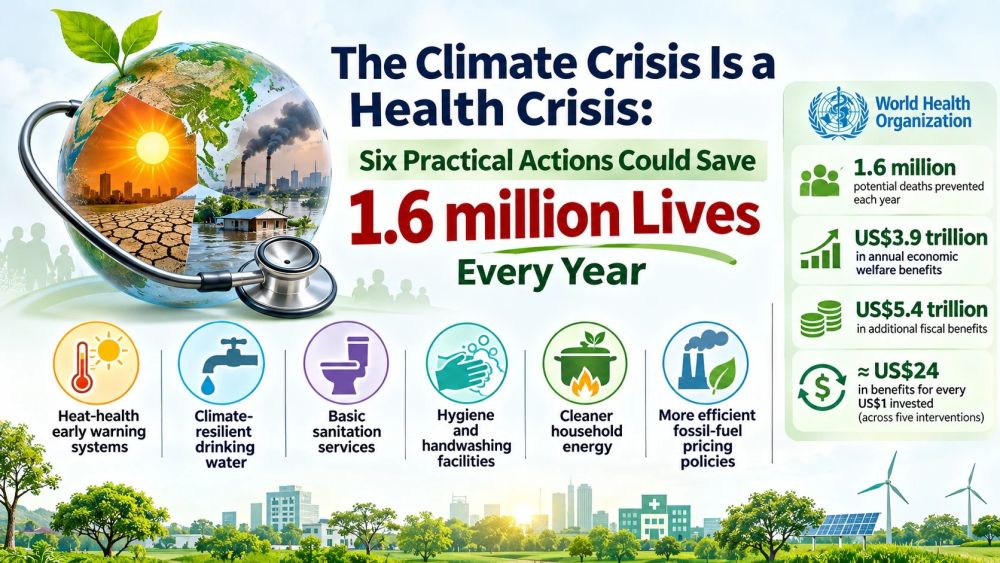
51/2026
Climate change is no longer just about melting glaciers, rising temperatures, or disappearing forests. It is increasingly a crisis for human health and survival. Behind every scorching heatwave, devastating flood, prolonged drought, and cloud of polluted air lies a human story of lives endangered, livelihoods destroyed, and communities struggling to survive. The true cost of climate change is measured not merely in degrees of warming or tons of carbon emissions, but in human suffering, preventable diseases, and lost lives.
A report released by the World Health Organization (WHO) on November 4, 2026, sharpens this human dimension. Its findings are remarkable: six practical climate and health interventions, if expanded globally, could prevent approximately 1.6 million deaths each year. They could also generate US$3.9 trillion in annual economic welfare benefits and an additional US$5.4 trillion in fiscal benefits.
The report, titled Global Benefits and Costs of Prioritized Actions on Climate Change and Health, sends a clear message to governments, healthcare professionals, researchers, and citizens: many health consequences of climate change can be prevented with measures that are already available. We do not have to wait for revolutionary technologies or costly medical discoveries to begin saving lives.
When the weather becomes a health emergency
Climate change affects human health in ways that are sometimes direct and sometimes less obvious. Extreme heat can cause dehydration, heat exhaustion, kidney injury, and potentially fatal heatstroke. Air pollution worsens asthma and other respiratory conditions and increases cardiovascular risk. Flooding can contaminate drinking water, damage sanitation facilities, and increase exposure to infectious diseases. Drought can undermine food production, nutrition, and household livelihoods.
These consequences do not affect everyone equally. Older people, young children, pregnant women, outdoor workers, people with existing health problems, and economically disadvantaged communities are often particularly vulnerable.
The WHO estimates that about 3.6 billion people live in areas highly vulnerable to climate change. This makes climate-related health protection an international public health priority, rather than a concern limited to environmental scientists.
Six actions proposed by the WHO Report that could save millions of lives
1. Heat-health early warning systems
One of the simplest ways to protect people from extreme heat is to issue warnings before dangerous temperatures arrive. Early warning systems can send alerts via mobile phones, television, radio, and community networks. Hospitals can prepare for more heat-related emergencies, while schools, workplaces, and local authorities can adjust outdoor activities.
People can also be advised to drink sufficient water, avoid strenuous activity during peak heat, and check on elderly neighbors and vulnerable family members.
The WHO analysis identifies heat-health warning systems as particularly cost-effective. It estimates that every US$1 invested in these systems could yield US$835 in benefits under its modeled assumptions. This underscores how relatively modest preventive investments can deliver substantial health and economic value.
2. Climate-resilient drinking water
Safe drinking water is fundamental to human health. Floods can contaminate wells, pipelines, and water-treatment facilities, while droughts can reduce clean water availability. Communities without reliable water infrastructure are especially exposed to diarrheal diseases and other infections.
Investing in protected water sources, reliable treatment facilities, resilient distribution networks, and regular water-quality monitoring can prevent illness and protect communities during climate emergencies.
3. Basic sanitation services
Sanitation is not merely a matter of convenience or cleanliness; it is an essential public health service. Poor sanitation allows disease-causing microorganisms to enter the environment and contaminate water and food.
Building and maintaining safe sanitation facilities, improving wastewater management, and ensuring facilities remain functional during floods and other disasters can reduce infectious disease transmission.
4. Hygiene and handwashing facilities
Handwashing with soap remains one of the most effective and affordable ways to prevent many infectious diseases. Yet millions of people still lack reliable access to water and to basic hygiene facilities.
Schools, hospitals, workplaces and communities need accessible handwashing stations, clean water and public education about hygiene. These investments become even more important when extreme weather disrupts essential services.
5. Cleaner household energy
Millions of households continue to rely on polluting fuels and traditional technologies for cooking and heating. Smoking in poorly ventilated homes contains harmful particles and gases that can damage the lungs and cardiovascular system.
Women and children often face particularly high exposure because of the time they spend near household cooking.
Expanding access to cleaner cooking fuels, electricity, and appropriate technologies can reduce household air pollution and lower greenhouse gas emissions. This environmental intervention can deliver immediate health benefits.
6. More efficient fossil-fuel pricing policies
The sixth intervention concerns government policy and economics. Fossil fuels such as coal, oil and gas contribute to air pollution and greenhouse gas emissions. Their health and environmental costs are often not fully reflected in their market prices.
The WHO recommends more efficient fossil-fuel pricing, including reforming inefficient subsidies and appropriately accounting for the wider costs of pollution.
Such reforms require careful planning. Governments must consider the impact on low-income households, workers and industries. Revenue generated through appropriate pricing policies can help support cleaner energy, public transport, healthcare and social protection.
Taken together, the report estimates that this intervention could deliver particularly substantial health, economic and fiscal gains.
Why prevention is a better investment
The WHO report's most important message is about preventive measures.
Across five of the six interventions assessed through benefit-cost analysis, every US$1 invested could generate approximately US$24 in benefits over time. These are model-based estimates, not guaranteed financial returns, but they demonstrate the enormous potential value of investing in preventive public health.
The report also estimates that scaling up the six interventions could avoid approximately 16.7 billion tons of carbon dioxide equivalent emissions over several decades.
This reminds us that protecting human health and protecting the environment are not competing priorities. In many cases, they are two sides of the same challenge.
A wake-up call for developing countries
For developing and underdeveloped nations, the findings deserve particular attention. Heatwaves, floods, water insecurity, air pollution, and inadequate sanitation challenge communities and healthcare systems.
A heat-health warning program should link hospitals, primary healthcare facilities, educational institutions, local administrations, and community organizations. Water and sanitation infrastructure must be designed to withstand floods and periods of water scarcity. Cleaner household energy should become an important component of national preventive healthcare policy.
Universities also play a significant role. Medical schools, public health departments, environmental scientists, engineers, and technology specialists should collaborate to develop locally appropriate solutions. Research must increasingly move beyond identifying problems toward testing interventions that can be implemented in communities.
Healthcare professionals should also be trained to recognize climate-related health risks. A physician treating dehydration, respiratory illness, or infectious disease may, in fact, be addressing the medical consequences of a much broader environmental problem.
Making health central to climate policy
The WHO report offers a timely message as governments prepare for international climate negotiations: climate commitments should be measured not only by emissions reductions but also by improvements in people's health and well-being.
Still, the figures are based on modeled global scale-up scenarios spanning several decades, and actual results will depend on investment, implementation, local conditions, and sustained political commitment. Nevertheless, the evidence provides a compelling case for action.
Climate change is often framed as a challenge for future generations, but its health consequences are already affecting people today. The opportunity to prevent illness and save lives is immediate.
According to Prof. Emeritus Dr. Muhammad Mukhtar, Rector of the University of Southern Punjab, Multan, Pakistan, and Editor-in-Chief of Greeningdotlive, the real measure of climate action should not be how many trees we plant, how many renewable-energy projects we announce, or how many international agreements we sign. It should also be measured by how many children breathe cleaner air, how many families have safe drinking water, how many older adults survive extreme heat, and how many preventable deaths our health systems can avert.