Greening Education: Reimagining Learning for a Climate-Resilient Future
Posted 5 months ago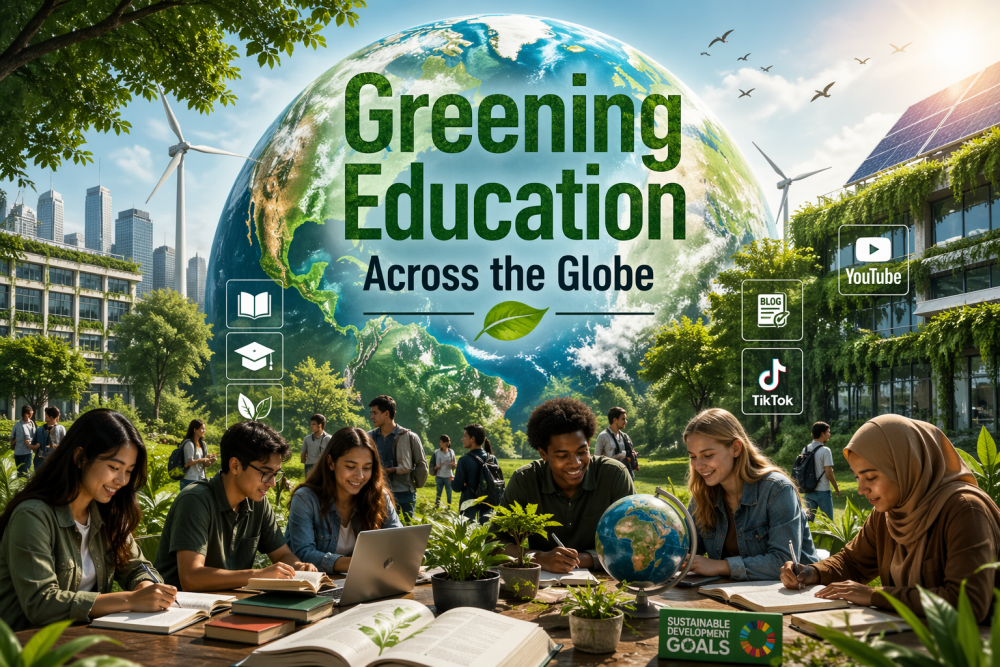
18/2026
In an age of growing environmental awareness and collective resolve, education is evolving from a passive transfer of knowledge into a powerful force for positive change. It now stands at the forefront of efforts to address one of humanity’s most pressing challenges. The concept of “greening education” is not merely a trend but a timely and inspiring opportunity, a transformative reimagining of how societies can prepare their citizens to live, work, and lead with responsibility, innovation, and hope in a rapidly changing world.
Drawing on the latest UNESCO framework, Greening Curriculum Guidance: Teaching and Learning for Climate Action (2024), this article explores how education systems must evolve from static institutions into dynamic engines of sustainability, resilience, and global responsibility.
From Awareness to Action: The New Purpose of Education
Education has long been recognized as a fundamental human right and a cornerstone of sustainable development. Yet today, its role must extend far beyond literacy and employability. It must empower learners to become agents of change by equipping them not only with knowledge but also with the values, skills, and motivation to act on climate challenges.
The UNESCO guidance underscores a sobering reality: nearly 47% of national curricula worldwide do not explicitly address climate change, and a significant share of youth lack even a basic understanding of its principles. This gap is not merely academic; it is existential.
Greening education addresses this deficiency by embedding climate literacy across all levels of learning, from early childhood through lifelong learning, and inspiring educators and policymakers to see this as a shared responsibility in meeting the bold global target: 90% of countries to integrate climate education into their curricula by 2030.
A Holistic Vision: Beyond the Science Classroom
Traditionally, climate education has been confined to the scientific disciplines of biology, geography, and environmental science. But the climate crisis is not only scientific; it is social, economic, political, and ethical.
Greening education adopts a holistic, interdisciplinary approach, integrating climate themes across subjects:
• Science: understanding greenhouse gases, ecosystems, and climate systems
• Economics: transitioning to circular and post-carbon economies
• Social sciences: examining climate justice and inequality
• Humanities: fostering ethical reflection and cultural perspectives
• Technical education (TVET): preparing for green jobs and sustainable industries
This shift transforms education from learning about climate change to learning for climate action.
The Four Pillars of Greening Education
The UNESCO framework identifies key principles that underpin effective greening education:
1. Action-Oriented Learning
Education must move beyond theory to practice. Learners should engage in real-world problem-solving, community projects, and climate action initiatives. Knowledge alone does not drive behavior; agency does.
2. Justice and Equity
Climate change disproportionately affects vulnerable populations. Education must incorporate climate justice, human rights, gender equity, and intergenerational responsibility to ensure that learners understand both the causes and consequences of inequality.
3. Scientific Integrity with Emotional Intelligence
While scientific accuracy is essential, education must also address the emotional dimensions of climate change, including eco-anxiety, fear, and uncertainty, by cultivating hope, resilience, and constructive engagement.
4. Lifelong and Contextual Learning
Greening education is not confined to classrooms. It extends to communities, workplaces, and informal settings, adapting to local contexts, indigenous knowledge, and cultural realities.
Pedagogy for Transformation: How We Teach Matters
One of the most profound insights from the UNESCO guidance is that how we teach is as important as what we teach.
Effective greening education requires:
• Learner-centered approaches: empowering students to construct knowledge actively
• Experiential learning: fieldwork, simulations, and real-world engagement
• Critical pedagogy: questioning systems, policies, and power structures
• Collaborative learning: working with communities and stakeholders
• Problem-based learning: tackling real environmental challenges
Such approaches foster not only understanding but also behavioral change, bridging the gap between awareness and action.
From Classrooms to Communities: A Whole-System Approach
Greening education is not merely a curriculum reform; it is a systemic transformation.
According to the framework, effective implementation requires:
1. Policy alignment with sustainability goals
2. Inclusive stakeholder participation (including youth voices)
3. Integration across subjects and education levels
4. Teacher training and professional development
5. Development of learning resources and assessments
6. Institutional transformation (green campuses, practices)
7. Continuous monitoring and evaluation
This whole-institution approach ensures that sustainability is not taught in isolation but is lived as part of the educational experience.
The Role of Youth: From Learners to Leaders
A defining feature of greening education is its responsiveness to youth demands. Around the world, young people are calling for education that prepares them not only to understand the climate crisis but also to change it.
They demand:
• Interdisciplinary learning
• Real-world engagement
• Inclusion in decision-making
• Education that fosters activism and leadership
Greening education answers this call by positioning youth not as passive recipients, but as co-creators of sustainable futures.
Challenges and Opportunities: The Road Ahead
Despite growing momentum, significant challenges remain:
• Limited teacher preparedness
• Curriculum overload
• Political and institutional inertia
• Inequities in access to quality education
Yet, these challenges are outweighed by the opportunity to redefine education itself.
As the UNESCO framework emphasizes, education is not merely a sector; it is a solution. It can shape mindsets, influence behavior, and drive systemic change at scale.
Aligning with UNESCO's vision, the University of Southern Punjab, Multan, Pakistan, takes well-deserved pride in pioneering an important academic and societal initiative by introducing one of the country’s first courses aligned with the philosophy of greening education. The course, Introduction to Environmental Science, delivered through blogs, YouTube videos, and TikTok, reflects a forward-looking model of digital, accessible, and youth-centered climate education. By meeting learners where they are on the platforms they actively use, the university is not only expanding its outreach but also democratizing knowledge. This initiative offers several tangible benefits: it enhances climate literacy among a broader audience, fosters behavioral change through relatable, bite-sized content, bridges the gap between formal and informal learning environments, and cultivates a culture of environmental responsibility among young people. Moreover, by leveraging social media for academic purposes, the university is setting a precedent for modern universities to become active participants in public awareness and sustainability advocacy, rather than remaining confined within traditional classroom boundaries.
Conclusion: Education as Climate Action
Greening education represents a paradigm shift from knowledge transmission to transformative action.
It calls for a new social contract in which schools, universities, and training institutions become incubators of sustainability, resilience, and innovation. It demands that educators become facilitators of change and that learners become architects of a greener future.
In the words echoed throughout the UNESCO guidance, the goal is clear:
To make every learner climate-ready and every education system a force for planetary survival.
The climate crisis may define our century—but through greening education, it can also define our collective response.