74/25 Lecture 6 ECOSYSTEM - The Secret Harmony of Life: How Everything on Earth Is Connected?
Posted 11 months ago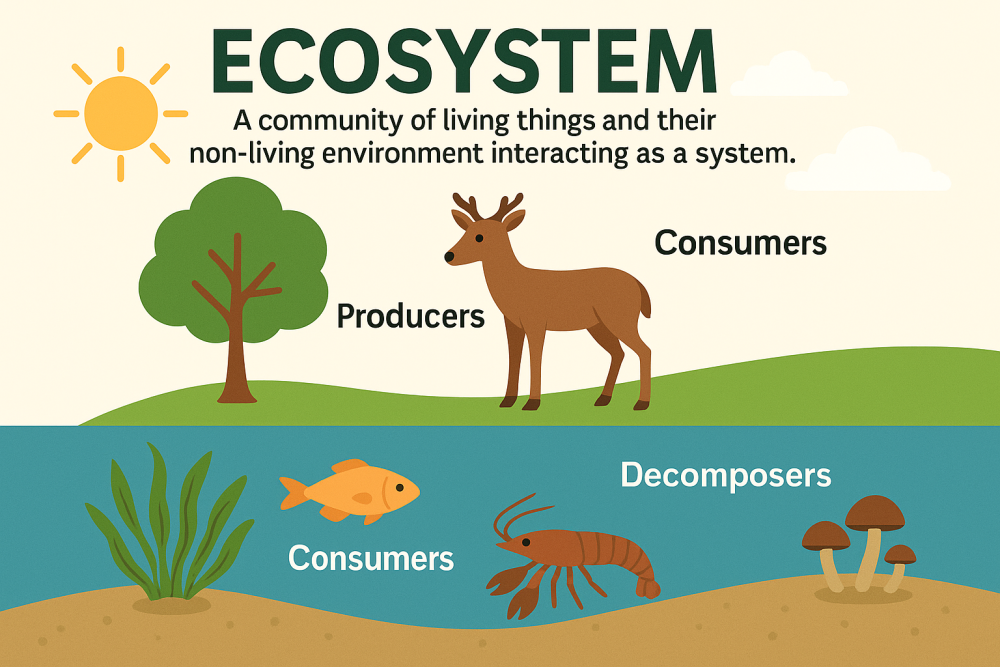
Lecture Video is available HERE
Walk outside on a sunny day, and the quiet miracle of life at work surrounds you. The air you breathe, the tree that shades you, the soil beneath your feet — all belong to a vast, interconnected web known as the ecosystem. It’s nature’s way of reminding us that nothing truly stands alone.
The word ecosystem combines two simple ideas: “eco,” meaning home, and “system,” meaning a network of parts working together. It describes every living thing and the non-living surroundings that sustain it, from the tiniest bacteria in the soil to the most enormous whale in the sea. Together, they form the heartbeat of our planet.
Livings and Non-Livings
An ecosystem isn’t just about animals and plants. It’s about relationships, how life interacts with sunlight, water, minerals, and air. Imagine a coral reef: small fish dart among colorful corals, plankton drift through warm waters, and sunlight filters down like gold dust. Life and the environment move perfectly, depending on each other to survive.
The environment surrounding us includes living humans, animals, plants, nonliving things like air, water, soil, sunlight, and temperature. Every living being depends on this environment for food, shelter, and the conditions to grow. In turn, we shape and change our surroundings gently and drastically.
This exchange is so natural we barely notice it, yet it defines our existence.
The Living and the Lifeless: Two Sides of the Same Story
So, what separates the living from the non-living? Living things grow, move, breathe, and reproduce. They heal, change, and create more life. Non-living things, such as rocks, mountains, the pen in your hand, and even your cell phone, do none of these.
And yet, the lifeless world shapes how life exists. Rocks form mountains, mountains direct rivers, and rivers carve valleys where civilizations rise. As one saying beautifully puts it:
“Life is not just about motion; even the wind moves. What makes living things special is their ability to grow, adapt, and create more life.”
Earth finds balance in this dance of the living and non-living.
Ecology: The Science of Connection
The study of these relationships is called ecology, the branch of science that examines how organisms interact with each other and their surroundings. Ecology teaches us that every breath we take, every drop of water we drink, and every meal we eat results from countless unseen connections between living and non-living parts of nature.
When one element changes, say, air pollution increases or forests disappear, the effects ripple across the web of life. Ecology reminds us that our planet is not a collection of isolated parts but a living, breathing network of cooperation.
From a Single Organism to the Entire Planet
Every grand story begins small. In nature, it starts with a single organism, a species capable of reproducing and passing life forward. A goat gives birth to another goat, and an oak tree grows more oaks. This is biological continuity, life renewing itself generation after generation.
When individuals of the same species live together in one place, they form a population. Think of a herd of goats grazing in a field. The number of goats is the population size; how crowded they are is the population density. Both tell scientists how much food, space, and water are available to sustain them.
But nature doesn’t stop there. Different populations — goats, grasses, insects, and birds come together to form a community, a neighborhood of life. Some species compete, others cooperate, but all are linked in a web of survival.
At the highest level of organization lies the biosphere, the grand stage for all life. It includes every forest, ocean, mountain, and desert, all connected by the air we breathe and the water we share. Here, the concept of interdependence takes on global meaning. Cut a forest in one corner of the planet, and the effects can ripple thousands of miles away.
“The biosphere is not just where life exists; it is where life connects.”
The Homes of Life: Ecosystems Across the Planet
Life on Earth flourishes in three main types of ecosystems: terrestrial, aquatic, and artificial.
- Terrestrial ecosystems include deserts, grasslands, and mountains. From the cactus that stores water to the snow leopard that prowls rocky slopes, every organism here is adapted to its climate.
- Aquatic ecosystems cover rivers, lakes, and oceans. Marine life, from plankton to whales, forms the richest biodiversity known to humanity.
- Artificial ecosystems are human-made mango orchards, wheat fields, and city parks. Though managed by us, they still depend on sunlight, water, and soil — the gifts of nature.
The Architecture of Life: Biotic and Abiotic Pillars
Every ecosystem stands on two pillars: biotic (living) and abiotic (non-living) components.
The biotic world, plants, animals, and microbes, captures energy, moves, and recycles nutrients. The abiotic world, sunlight, air, water, and minerals, provides the foundation. Together, they create the dynamic balance that keeps the Earth alive.
If one side falters, the harmony collapses. Ecology teaches us a simple truth: disturb the balance, and the song of life starts to fade.
Producers, Consumers, and Decomposers: Nature’s Endless Cycle
Every ecosystem has three key actors in the circle of life: producers, consumers, and decomposers.
- Producers - plants, create food through photosynthesis, converting sunlight, carbon dioxide, and water into energy.
- Consumers - animals, rely on these plants or on other animals for their energy needs.
- Decomposers - tiny microorganisms that break down dead matter, returning nutrients to the soil for plants to use again.
This never-ending cycle keeps the Earth’s systems running as a quiet reminder that nothing in nature goes to waste.
The Human Role in Nature’s Web
Humans occupy a special place in this cycle. We are omnivores, capable of eating plants, herbivores, or carnivores. Sometimes we act as primary consumers when we eat vegetables, secondary when we eat meat, and tertiary when we consume animals that eat other animals.
Our adaptability gives us power and responsibility. We stand at multiple points in the food chain, and our choices ripple through the entire ecosystem.
When we understand this, we see that ecology isn’t a distant scientific concept. It’s a mirror showing us our place in the living world.
The Final Lesson: Everything Is Connected
In nature's grand design, the producers create, the consumers transform, and the decomposers renew. The energy that flows through them never disappears; it only changes form.
Plants act as the planet’s lungs, cleaning our air and sustaining every creature. Decomposers recycle life back into the soil. The sun remains the ultimate source of all energy, a silent engine that powers everything.
The message of ecology is simple, yet profound: life and non-life exist in harmony, bound by invisible threads of balance and reciprocity. Disturb one, and the whole system trembles.
Looking around our warming planet, we might recall humility as the most outstanding ecological virtue. The Earth's health and humanity's survival are, in truth, one and the same story.
Questions/Answers
🟩 Section A: Descriptive Questions
1. Define an ecosystem. Explain its main components with examples.
Answer:
An ecosystem is a community of living organisms (plants, animals, microorganisms) interacting with one another and with the non-living environment (air, water, sunlight, soil, and minerals) in a particular area.
-
Biotic components: Living organisms such as fish, plants, and microbes.
-
Abiotic components: Non-living elements like water, temperature, and sunlight.
For example, a marine ecosystem includes small fish, algae, and water as key components, working together in a balanced system.
2. Differentiate between living and non-living components of the environment. Provide examples.
Answer:
-
Living (biotic) components include humans, animals, and plants that grow, reproduce, breathe, and respond to their environment.
-
Non-living (abiotic) components include air, water, soil, sunlight, and temperature, which do not grow or reproduce but are essential for life.
Example: Plants (living) depend on sunlight and soil (non-living) for survival.
3. What is ecology, and why is it important?
Answer:
Ecology is the branch of science that studies the interaction of living organisms with one another and with their environment.
It helps us understand interdependence — how humans, animals, and plants depend on air, water, soil, and sunlight. Ecology teaches that all elements of nature are connected, and disturbance in one affects the whole system.
4. Describe the terms: species, population, community, and biosphere.
Answer:
-
Species: A group of similar organisms capable of interbreeding, e.g., all goats form one species.
-
Population: Individuals of the same species living in one area, such as a herd of goats in a field.
-
Community: Different populations living and interacting in one area, e.g., goats, plants, and humans.
-
Biosphere: The global system that includes all living beings and their environments on Earth.
5. Explain the three main types of ecosystems with examples.
Answer:
-
Terrestrial Ecosystems – Found on land; includes deserts, grasslands, and mountains.
-
Aquatic Ecosystems – Found in water; includes freshwater (rivers, lakes) and marine (oceans, coral reefs).
-
Artificial Ecosystems – Human-made, such as gardens, agricultural fields, or aquariums.
6. Describe the roles of producers, consumers, and decomposers in an ecosystem.
Answer:
-
Producers: Plants and algae that make food through photosynthesis using sunlight, carbon dioxide, and water.
-
Consumers: Animals that depend on plants or other animals for food.
-
Decomposers: Microorganisms that break down dead material, returning nutrients to the soil.
Together, they maintain the flow of energy and cycling of nutrients in nature.
7. How do humans fit into the food chain? Explain with examples.
Answer:
Humans are omnivores and occupy multiple levels in the food chain:
-
Eating plants → act as primary consumers.
-
Eating herbivores → act as secondary consumers.
-
Eating carnivores → act as tertiary consumers.
This flexibility allows humans to adapt to diverse diets but also gives them a major role in shaping ecosystems.
🟦 Section B: Multiple Choice Questions (MCQs)
1. The word “eco” in ecosystem is derived from the Greek word oikos, which means:
A. Energy
B. Life
C. Home
D. Earth
✅ Answer: C. Home
2. Which of the following best defines an ecosystem?
A. A collection of non-living things only
B. Living organisms interacting with each other and their environment
C. Only animals and plants in one place
D. A single species living in an area
✅ Answer: B
3. Which of the following is NOT a biotic component?
A. Bacteria
B. Fungi
C. Water
D. Humans
✅ Answer: C. Water
4. Which process allows plants to produce their own food?
A. Respiration
B. Photosynthesis
C. Fermentation
D. Decomposition
✅ Answer: B
5. What is the main source of energy in an ecosystem?
A. Water
B. Soil
C. Sunlight
D. Oxygen
✅ Answer: C
6. A group of similar organisms that can interbreed and produce fertile offspring is called a:
A. Community
B. Population
C. Species
D. Biosphere
✅ Answer: C
7. The main difference between producers and consumers is that:
A. Producers depend on animals for food
B. Producers make their own food; consumers cannot
C. Consumers make food using sunlight
D. Consumers do not need energy
✅ Answer: B
8. Which of the following is a decomposer?
A. Deer
B. Eagle
C. Bacteria
D. Cow
✅ Answer: C
9. The biosphere includes:
A. Only oceans
B. Only the atmosphere
C. All living organisms and environments on Earth
D. Only forests and deserts
✅ Answer: C
10. Humans are considered omnivores because they:
A. Eat only plants
B. Eat both plants and animals
C. Produce their own food
D. Live in all ecosystems
✅ Answer: B
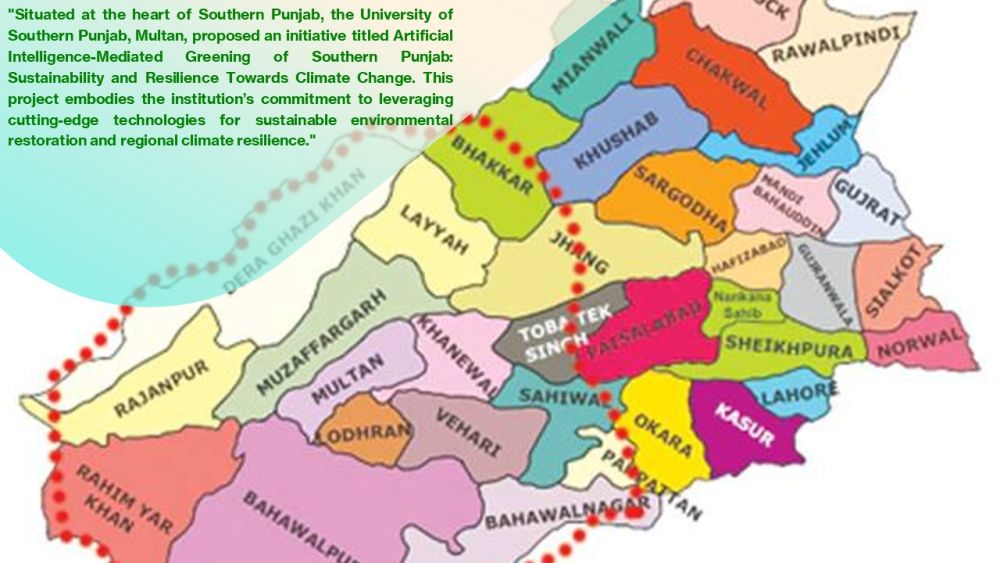
The University of Southern Punjab, Multan, Pakistan, recognizes education as a shared social responsibility and a powerful instrument for community uplift. The University reinforces its commitment to environmental awareness, sustainable living, and civic engagement by offering the Introduction to Environmental Science course to students and the general public. This initiative enriches students’ understanding of how natural systems support life and empowers the wider community to make informed decisions for a cleaner, healthier, and more sustainable future. Through this program, USP takes a leading role in transforming knowledge into action, inspiring and motivating the collective well-being of South Punjab and beyond.